
Protein purchasing is rarely, if ever, one-size-fits-all. Market conditions shift, supplier relationships evolve, and business needs change fast. Consider how strained the beef market became in 2025. The buying strategy that secures the highest quality protein at the best deals in Q1 may not yield the same results in Q3.
The most effective procurement teams, including our own at Miniat, use every purchasing strategy in their arsenal to deliver the best possible deal, no matter what the market looks like.
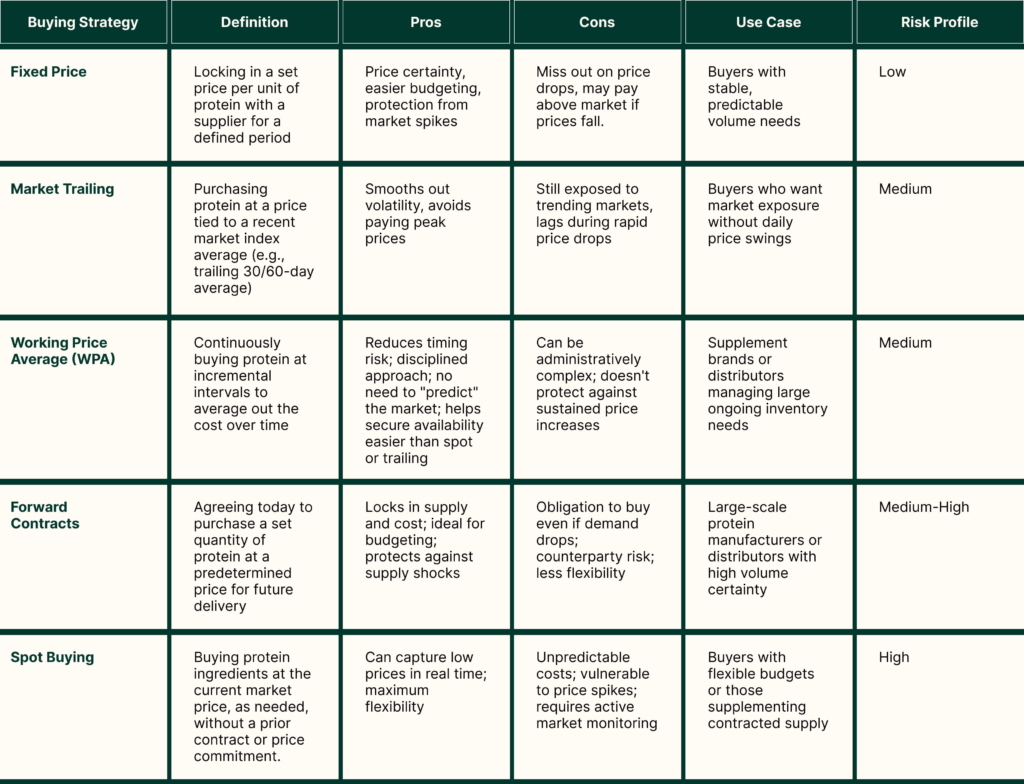
Here’s a breakdown of the five core buying strategies, what makes each one work, and when suppliers should reach for them.
How to Choose the Right Strategy
These strategies should rarely be relied on individually—a mixture of strategies is much more advantageous. If the world were a stable market, spot buying and talking with a broker would be sufficient. But when prices spike or supplies tighten, that model breaks down.
As Kevin Speed, Miniat’s Senior Procurement Manager, puts it: “We always push to introduce flexibility in our purchasing strategies. That enables us to buy at the most opportune time while also reducing risk for our customers and us.”
Picture a protein manufacturer who gets a heads-up from their supplier that market conditions are shifting, and prices are about to dip. Instead of waiting for their next scheduled purchase, the manufacturer moves quickly and buys in while the price is favorable.
A buyer with a fixed contract wouldn’t have had that flexibility. A buyer just following a rolling average wouldn’t have been able to move fast enough. The relationship and the willingness to act made the difference.
The Power of Mixed Buying Strategies
In addition to showcasing flexibility, these examples highlight the benefit of combining multiple purchasing strategies, rather than going all in on just one. Here are some buying strategy combinations worth thinking about:
- Fixed Price + Spot Buying: Lock in base volume at a fixed price to protect your operations, then use spot buying to capture opportunistic dips.
- Forward Contracts + Market Trailing: Secure a portion of future supply via forward contracts while locking in the rest to a trailing market index.
- WPA + Spot Buying: Use WPA as your baseline purchasing cadence, then layer in spot buys when protein prices fall meaningfully below your running average.
- Forward Contracts + Fixed Price: Use forward contracts to lock in supply six months out, then use a fixed price to replenish supply before the forward delivery arrives.
Getting the strategy mix right is half the battle. The other half is avoiding the mistakes that can quietly erode the value of even the best purchasing plan.
Common Purchasing Mistakes to Avoid
Even experienced buyers can leave value on the table. Protein procurement is more exposed than many categories because freshness, temperature control, and shelf life can turn a small planning error into a major loss. Here are a few common purchasing pitfalls that procurement managers should watch out for:
- Not diversifying suppliers, which can create single-source risks when one of their processes gets disrupted.
- Buying based on lowest price alone instead of the total cost, which may result in hidden costs from spoilage, delayed delivery, or service failures.
- Not aligning procurement strategies with the overall manufacturing strategy, leading to decisions that look good on paper, but fall short during production.
- Skipping thorough supplier vetting, including safety controls, capacity, financial stability, and reliability.
- Failing to monitor supplier performance with KPIs like on-time delivery, defect rate, responsiveness, and fill rate.
Stay Proactive in Protein Purchasing
Many procurement teams start out reactive by default, responding to supply gaps, price spikes, and customer pressures as they occur. Proactive buyers, by contrast, are already well-positioned before the market moves.
In practice, proactive buyers build inventory deliberately, lock in advantageous pricing before the broader market catches on, and cultivate supplier relationships that give early reads on supply conditions, not just an invoice after the market is already in motion.
That’s not to say a proactive protein purchaser always predicts the market accurately—no one in procurement is a psychic. There will always be unexpected global disruption and shifting market demands to capitalize on.
The difference between a reactive and proactive procurement strategy is ultimately about control. Check out how this type of procurement strategy bolsters a robust commercialization process in our latest guide: How to Successfully Commercialize Your Next Protein.